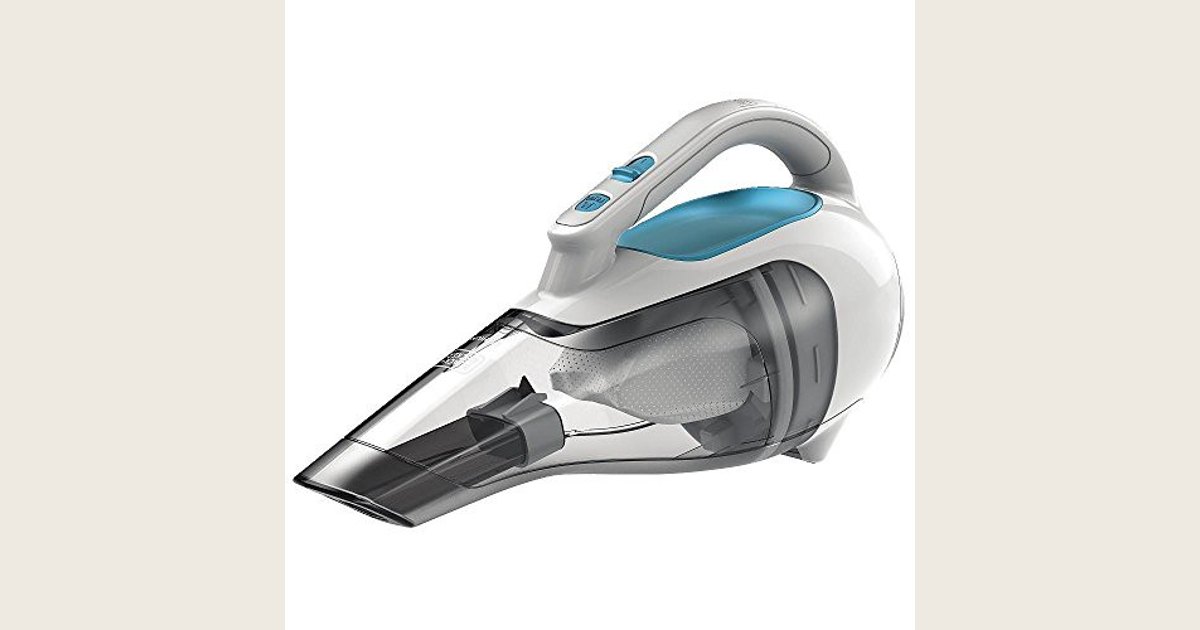
A good handheld car vacuum is the one you will actually take out for crumbs, floor mats, seat seams, and small dry messes before they become a bigger cleaning job. For most drivers, prioritize a compact body, a real crevice tool, straightforward dustbin emptying, a filter you can maintain, and enough runtime for one normal interior cleanup.
Do not choose solely by a voltage number, an air-watt claim, or a marketing word such as “high power.” Those specifications only make sense alongside the tool, power mode, runtime conditions, and type of debris involved. A handheld is best for quick, targeted cleaning and awkward gaps. It is not automatically the right replacement for a full-size vacuum when you routinely deep-clean several vehicles, deal with heavily embedded pet hair, or want to clean an entire interior in one long session. The buying decision is less about finding the biggest headline specification and more about matching the machine to where dirt accumulates in your vehicle.
Key takeaways
- A crevice tool, brush, and a comfortable grip are usually more useful in a car than a vague “high suction” label.
- Check the stated runtime and the test conditions. Runtime can change with the selected mode and attachment.
- A larger dustbin means fewer emptying breaks, but an easy-to-empty bin is just as important for routine car cleanup.
- A washable filter is not a zero-maintenance filter. Confirm how it is cleaned, dried, and replaced before you buy.
- Choose a charging and storage setup that fits your home or garage. Do not assume every vacuum marketed for cars plugs into a vehicle outlet.
Start with the jobs you actually need to do
Where does loose dirt gather in your car most often—on the mats, between the seats, or in the cargo area? Think about the last mess you wanted to remove. A handheld vacuum is a natural fit for dry crumbs on seats, grit in door pockets, loose dirt on mats, and debris along seat tracks. These are short jobs with tight access, so maneuverability and the right nozzle often matter more than carrying a large machine to the driveway.
Now consider the harder cases. Deep carpet cleaning, a large amount of sand, and dense pet hair may call for more runtime, a motorized tool, or simply a larger vacuum. A compact machine can still be useful between thorough cleans, but buying it with the wrong expectation creates disappointment. Decide whether you need a maintenance vacuum for brief sessions or an all-in-one solution for occasional full-detail days.
Also separate dry debris from liquids. A standard dry handheld should not be treated as a wet-dry vacuum. For example, Dyson explicitly says not to pick up water or other liquids with its Car+Boat handheld vacuum. Check the manual for the exact model rather than assuming that a car-oriented name means it can handle a spilled drink. Dyson’s Car+Boat guidance is one example of that limitation.
Judge power as a system, not one number
Manufacturers do not always present the same power measurement, and a number by itself does not tell you how a vacuum will handle a particular car-cleaning job. Voltage describes an electrical system, while other listings may emphasize air watts, motor speed, or a named power mode. Those are not interchangeable shopping shortcuts.
Instead, use the specification sheet to ask practical questions:
- Is there a crevice tool long and narrow enough for seat seams, between cushions, and around the center console?
- Is a soft brush included for vents, trim, and other delicate surfaces?
- Is there a motorized tool if your main challenge is carpeted mats or upholstery?
- Does the tool fit securely, and can you switch it without hunting for a separate accessory bag?
Official product pages show why the attachments deserve attention. The BLACK+DECKER HHVI315JO42 listing specifies both a crevice tool and an upholstery brush. Dyson lists a crevice tool, combination tool, and mini-motorized tool for its Car+Boat model. Those tools do not make either product a universal recommendation, but they illustrate the difference between a vacuum that can reach a gap and one that can only pass over the visible surface.
When comparing two models, put attachment usefulness ahead of a claim you cannot compare directly. A crevice tool will not make weak pickup stronger, but strong pickup is far less useful if the nozzle cannot reach the debris.
Runtime and charging: read the fine print
A stated runtime is useful only when you know how it was measured. Higher-power modes and motorized attachments can change it, so compare the footnotes as carefully as the headline. Dyson, for example, states up to 50 minutes for the Car+Boat in low mode with a non-motorized tool and notes that runtime may vary with use. BLACK+DECKER lists a 15-minute runtime for the HHVI315JO42. The Dyson specification and the BLACK+DECKER specification are useful examples of why an “up to” claim should not be read as a guarantee for every mode and task. For more battery-runtime context, see our cordless car vacuum guide.
Here is how the manufacturers present a few key specifications for those two models. This is a comparison of listed features, not a product recommendation.
| Listed detail | BLACK+DECKER HHVI315JO42 | Dyson Car+Boat |
|---|---|---|
| Runtime | 15 minutes | Up to 50 minutes in low mode with a non-motorized tool |
| Dustbin capacity | 400 ml | 0.14 gallon |
| Listed tools | Crevice tool and upholstery brush | Crevice, combination, and mini-motorized tools |
For many drivers, a shorter session can be perfectly workable if the vacuum is easy to grab and the job is limited to loose debris. If you expect to clean multiple rows, cargo space, or several cars at once, look for a runtime that leaves a margin after accounting for the way you will use it.
Then check the charging arrangement. A cordless handheld may include a plug-in charger, a charging base, or both. The BLACK+DECKER model above lists a jack-plug charger and wall-mount charging base, which can be convenient only if you have a suitable place to keep it. Plan for an accessible, dry storage location and follow the manufacturer’s charging and battery-care instructions for the specific model. Do not assume a cordless vacuum can be charged from a car socket, or that a 12-volt plug-in model can be charged at home.
If cordless convenience is your main priority, our cordless car vacuum buying guide goes deeper on runtime, filters, and the tradeoffs of battery-powered designs.
Capacity matters when the mess is bulky
Dustbin capacity controls how often you stop to empty, not how well the vacuum reaches into a tight space. A small bin can be fine for regular crumb cleanup. It becomes inconvenient when you pick up gravel, leaves, pet hair, or a season’s worth of debris from floor mats.
Read both the capacity and the bin design. Is the fill line visible? Can you open it over a trash can without touching the dirt? Does the opening allow larger debris to leave, or will it need to be pulled out by hand? The BLACK+DECKER listing gives its bin as 400 ml, while Dyson lists a 0.14-gallon bin for the Car+Boat. The different units are a reminder to compare the actual capacity, not just labels such as “large” or “high capacity.”
If storage space is limited, do not overcorrect by choosing the smallest possible vacuum. A slightly larger bowl and comfortable emptying mechanism can save frustration after a sandy trip or a snack-heavy road trip.
Filters and maintenance are part of the purchase
A handheld vacuum will not stay convenient if cleaning the filter is difficult or replacement parts are unavailable. Look for three things before checkout: the maintenance instructions, whether the filter is washable, and the replacement-filter part number.
Washable does not mean “never clean.” The BLACK+DECKER product page says its bowl and filters are washable and identifies replacement filter VF110FC. Dyson recommends washing the Car+Boat filters at least monthly and directs owners to the user guide for the procedure. Follow the instructions for your exact unit, including drying time, rather than reinstalling a damp filter or borrowing a method from a different model. BLACK+DECKER and Dyson both make model-specific care information part of their product support.
For shopping purposes, a replaceable filter with a clearly published part number is easier to plan around than a vague claim about filtration. If the listing does not explain basic maintenance or make parts easy to identify, look for the manual before buying.
Handheld, 12-volt, or corded: choose the inconvenience you prefer
Handheld cordless models are simplest to move around a car, but they must be charged before use. A 12-volt plug-in vacuum eliminates battery wait time but ties you to the vehicle outlet and cable length. A household-corded vacuum can provide a longer session, but it needs an outlet or extension strategy and can be cumbersome around doors and seats.
There is no universal winner. Choose cordless if you value grab-and-go touchups and will maintain a charging spot. Choose 12-volt if you want the vehicle to be the power source and accept the cable. Choose household power if you mostly clean at home and do not mind setup. For a closer look at the battery-powered option, compare these tradeoffs with our cordless car vacuum buying guide. In every case, verify the included charger or power plug, cable length where relevant, and whether the accessories match the gaps you need to reach.
A practical pre-purchase checklist
Before you buy a handheld car vacuum, confirm these details on the product page or in the manual:
- Cleaning target: crumbs and dust, floor mats, pet hair, or a combination.
- Attachments: at minimum, a crevice tool; add a brush or motorized tool only when it serves your surfaces.
- Runtime conditions: the claimed time, mode, and tool used in the manufacturer’s test.
- Dustbin: stated capacity, emptying mechanism, and whether the fill level is visible.
- Filter care: washing directions, drying requirements, and replacement-filter availability.
- Power setup: charger or plug type, charging base if included, and a realistic place to store it.
- Handling: weight, grip, trigger or switch placement, and whether you can reach under seats without straining.
- Limits: dry-only restrictions, warranty terms, and instructions that affect how you plan to use it.
Troubleshooting common disappointments
Weak pickup often has a simple cause. Empty the bin, inspect the nozzle and crevice tool for a blockage, and clean the filter only as the manufacturer directs. If the vacuum works on open carpet but not along a seat seam, switch to the crevice tool before assuming the motor is the problem. If it runs briefly, recharge it through the intended charger and compare the result with the stated runtime conditions.
A new vacuum can also feel disappointing when the task exceeds its format. Repeatedly trying to collect a large volume of heavy debris with a small bowl, or expecting a short-session handheld to deep-clean every carpeted surface, creates more stops and passes than the tool was designed to avoid. Use the handheld for the tight, frequent jobs it does best, then reserve larger cleanups for equipment with the capacity and runtime those jobs require.
Featured image credit: BLACK DECKER dusbuster Handheld Vacuum, Cordless, Flexi Blue (HHVI315JO42) by shop8447, CC0 1.0. Resized and padded. Illustrative stock photo; no product testing is implied.